
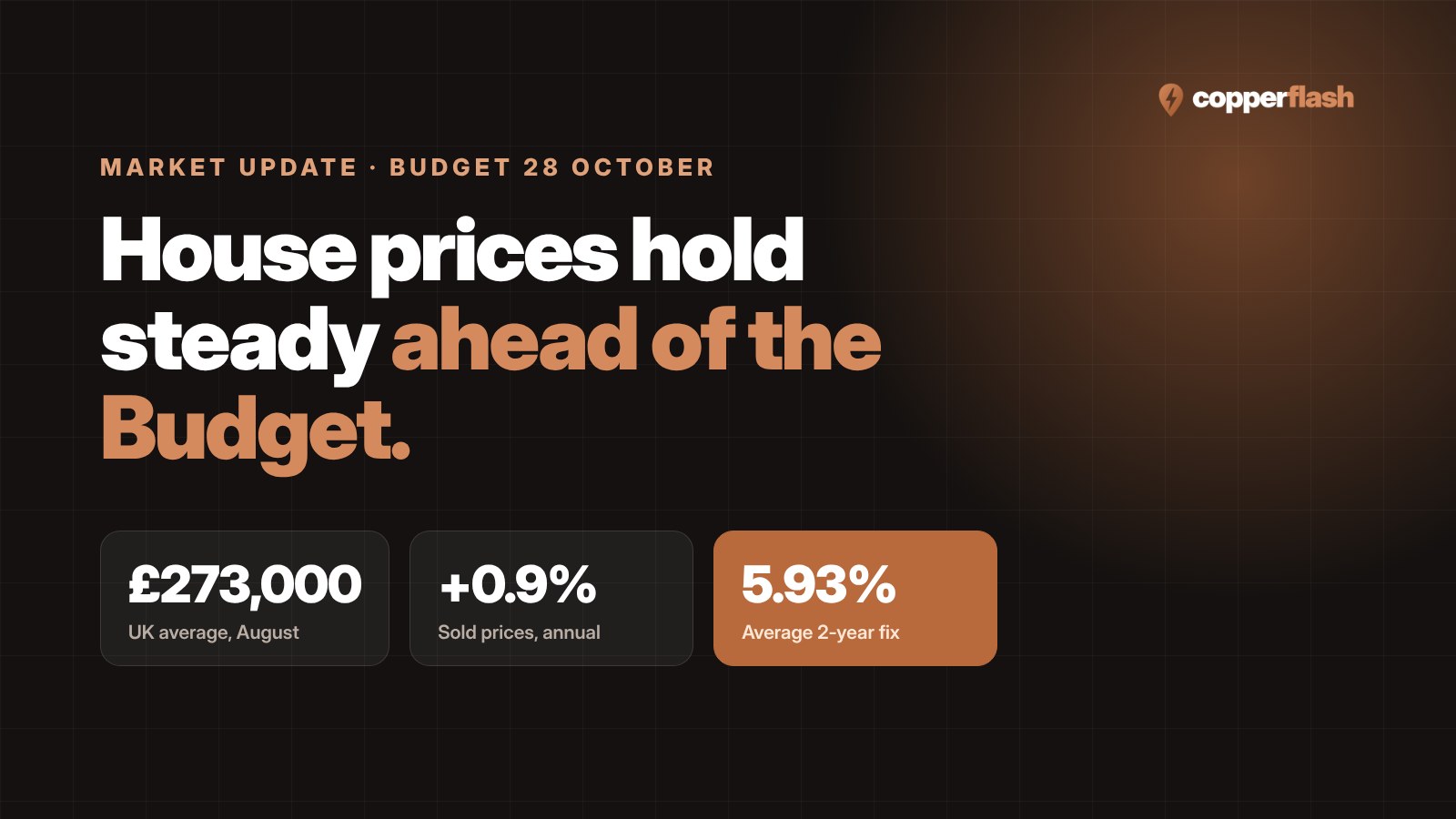
UK house prices are close to standing still this autumn, and the Budget on Wednesday 28 October is unlikely to change that overnight. The average UK home cost £273,000 in August, up just 0.9% on a year earlier, while mortgage rates have crept back up towards 6%.
For anyone moving, that adds up to a steady market rather than a frantic one: buyers have time to choose, and sellers who price sensibly still sell. Here’s what the latest numbers say, what is and isn’t on the table for the Budget, and what it could mean for your move.
Where house prices are now
Every major index shows prices broadly flat over the past year, with annual changes between -0.1% and +0.9%.
| Index | Latest month | Monthly change | Annual change |
|---|---|---|---|
| Land Registry (sold prices, UK average £273,000) | August 2026 | +0.3% | +0.9% |
| Nationwide (mortgage approvals) | September 2026 | -0.2% | +0.8% |
| Lloyds, formerly Halifax (mortgage approvals) | September 2026 | 0.0% | 0.0% |
| Rightmove (asking prices) | October 2026 | +1.0% | -0.1% |
The Land Registry figures are the most reliable because they use completed sales, but they run about two months behind. Rightmove shows what sellers are asking, not what buyers pay. Source: Which?, 21 October 2026
In the South West, the average home costs £304,139, unchanged on a year ago. The North East (+3.2%) and North West (+2.2%) are rising fastest; the South East is the only region falling, by 0.8% over the year.
Mortgages are the main brake. The average two-year fix is 5.93% and the average five-year fix 5.95%, and rates have been rising again as higher oil prices feed through.
The Budget on 28 October: what’s confirmed and what’s rumour
Chancellor John Healey delivers the Budget on Wednesday 28 October, and the government has already ruled out the change buyers would notice most: stamp duty stays as it is.
Confirmed or announced
- No stamp duty changes at this Budget. The Prime Minister said in July that changing or scrapping it “won’t be happening”, and also rejected reports of a single tax replacing stamp duty and council tax.
- High Value Council Tax Surcharge. An annual charge on homes in England worth £2m or more, starting April 2028. The consultation closed in July; the final design hasn’t been published.
- Your First Home. A new equity loan scheme for first-time buyers of new-build homes in England, announced in September and due to be confirmed in the Budget.
- Tax rises are not ruled out in general, so other changes are possible.
Rumoured or proposed, not policy
- Higher capital gains tax on property, lining it up with income tax rates.
- Higher annual charges on expensive homes held through companies.
- Stamp duty reform ideas from think tanks, developers and the opposition: a cap for first-time buyers and downsizers, or a yearly property tax in place of stamp duty and council tax. None of these can come in at this Budget.
Stamp duty today (England and Northern Ireland)
| Price band | Rate |
|---|---|
| Up to £125,000 | 0% |
| £125,001 to £250,000 | 2% |
| £250,001 to £925,000 | 5% |
| £925,001 to £1.5m | 10% |
| Over £1.5m | 12% |
First-time buyers pay nothing up to £300,000, on homes up to £500,000. Second homes and buy-to-lets pay an extra 5%. Scotland and Wales have their own rates. Source: Calculate My Stamp Duty, updated 22 October 2026
What it could mean for you
With stamp duty off the table, the Budget’s biggest effect on most moves will be indirect: on confidence, and on where mortgage rates go next.
- Buyers: A flat market gives you room to negotiate, and there’s no stamp duty deadline to rush for. Rising mortgage rates matter more than the Budget, so get an agreement in principle and know your budget at today’s rates.
- First-time buyers: Watch for the details of Your First Home on the day if you’re looking at new builds in England. Your stamp duty relief up to £300,000 stays the same.
- Sellers: With prices barely moving, the right asking price is what sells. Homes priced to the local market are still moving; over-optimistic ones are the ones that sit.
- Landlords: The extra 5% stamp duty stays, and a capital gains change is possible but unconfirmed. Worth checking with your accountant after the Budget before buying or selling.
- Renters: Nothing announced so far is aimed at renters directly.
- Homes worth £2m or more: The surcharge starts in April 2028, so there’s time, but the final design may be confirmed on the day.
This is general information, not financial advice. The Budget can include surprises, so check the details once they’re published.
What to do now
In a quiet market, the buyers who do best are the ones who see the right home first, not the ones who wait for the Budget.
- Know your numbers. Get a mortgage agreement in principle now, and work out your stamp duty with our stamp duty calculator.
- Save your search once. Tell CopperFlash your area, budget and must-haves, and we’ll check every new listing against it the moment it goes live.
- Let the street do the looking. Switch on Nearby alerts and your phone taps you when you pass a matching home, from 50m to 1,000m away.
- Read the Budget on the day, not the headlines before it. We’ll update this post after 28 October with anything that affects buyers, sellers and landlords.